

——SDC Launches New Zealand-Māori Culture Research Centre and Rewi Alley Research Institute
In active response to China’s high-quality joint development of the Belt and Road Initiative, and to contribute to global indigenous cultural conservation and deepen China-New Zealand cultural research, Shanghai Donghai College (SDC) has recently inaugurated the New Zealand-Māori Culture Research Centre and the Rewi Alley Research Institute. The two bodies form a key component of the International Cultural Exchange Innovation Project under SDC’s 15th Five-Year Plan for international exchange and cooperation. As college-level platforms for scientific research and academic exchange, the centre and the institute will align closely with SDC’s priorities including internationalised education provision, cross-cultural exchange, global outreach of vocational education and talent cultivation. Through practical initiatives, they will deliver on the Initiative to Enhance China’s Global Educational Influence set out in the 15th Five-Year Plan for Educational Development issued by the State Council, and strive to build a key exchange base for Chinese and international youth.
Shanghai Donghai College New Zealand-Māori Culture Research Centre
Māori culture is the unique cultural system of New Zealand’s indigenous Māori people. With profound historical roots and rich cultural connotations, it stands as a core indigenous heritage that New Zealand is committed to conserving. The Māori are descendants of Polynesian peoples who migrated to New Zealand from the Polynesian Islands around 1300 CE. Their ancestral origins stretch back to southeastern China roughly 4,000 years ago; their forebears travelled across Southeast Asia and New Guinea before eventually arriving in New Zealand. Māori culture took shape around the 10th century. For generations, the Māori have lived and thrived on Aotearoa — the Land of the Long White Cloud — and gradually forged their distinct cultural identity. The signing of the Treaty of Waitangi in 1840 formalised coexistence between the Māori and British settlers, securing the preservation of Māori culture. As the essence of New Zealand’s indigenous culture, Māori culture embodies profound philosophical insights, ecological wisdom and humanistic values. It shares close historical affinities and spiritual resonance with traditional Chinese culture, particularly in the ideals of harmony between humanity and nature, reverence for ancestors, emphasis on family lineage, collectivism and a strong sense of community belonging.
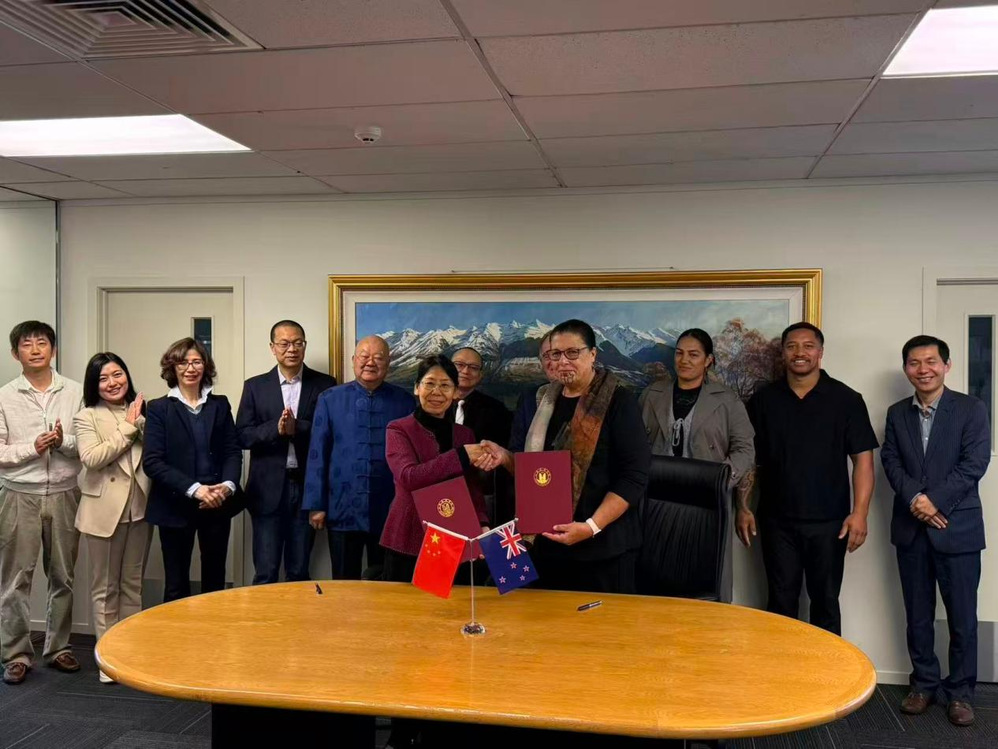
The Māori Culture Research Centre is jointly established by Shanghai Donghai College and the New Zealand Innovative Corporate Culture Exchange Center (IECC NZ), with support from the Faculty of Māori and Indigenous Studies at the University of Waikato, New Zealand.On 9 June 2026, SDC President He Ying led a delegation to the University of Waikato, where they held in-depth exchanges with Professor Tangiwai Rewi, Dean of the School of Māori and Indigenous Studies, and Te Kahautu Maxwell, Associate Dean for Postgraduate Affairs, School of Māori and Indigenous Studies. The delegation experienced the grand traditional rituals of Māori culture first-hand, gaining a deep appreciation of the unique charm and profound heritage of New Zealand’s indigenous culture.On 10 June 2026, President He Ying and Ms Marion Agnes Edwards, Chair of IECC NZ, signed a memorandum of understanding on the co-construction of the SDC Māori Culture Research Centre. Under the cooperation framework, the New Zealand partners will provide and recommend local New Zealand reference materials, resources and data. Selected researchers from both China and New Zealand will conduct academic exchanges and carry out joint research projects in either China or New Zealand.
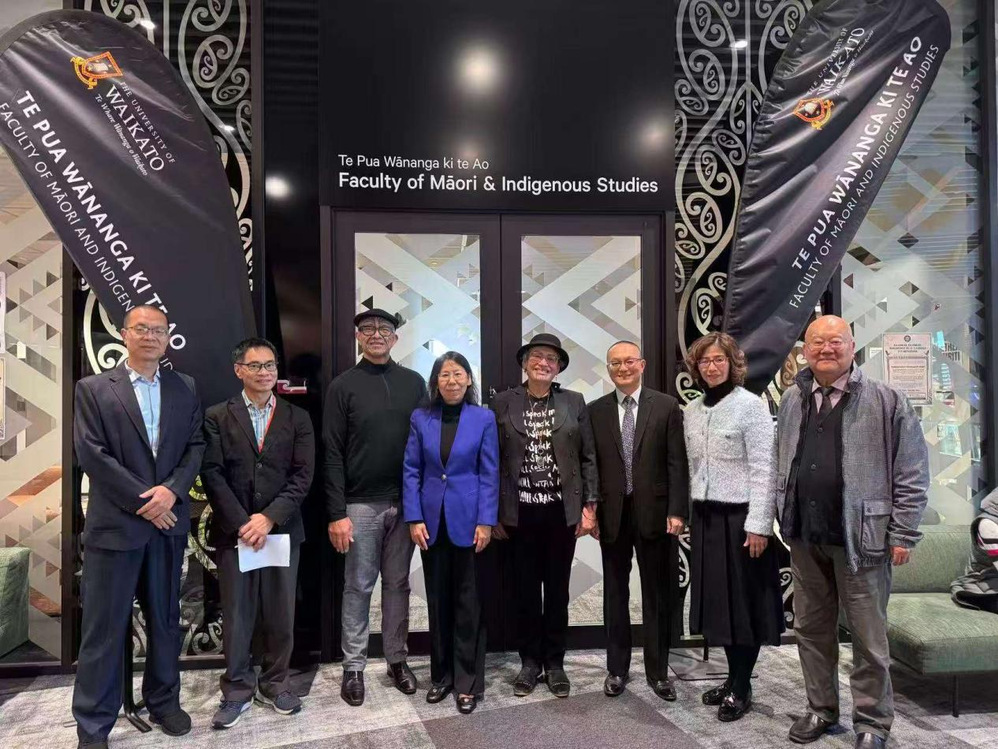
The Māori Culture Research Centre is dedicated to the documentation, restoration, development and innovation of New Zealand’s Māori culture amid urbanisation and the era of artificial intelligence.Dr. Jinming Chen, Chief Executive Officer of UUNZ College, New Zealand, and Ms. Marion Agnes Edwards, Chair of IECC NZ, serve as advisors to the Centre. Professor Meng Zhaoshang, Director of the Office of International Exchange at SDC, acts as the Centre’s Director. Dr. Huang He from SDC’s School of Education, hold the post of Deputy Director, and Ms. Liu Yichen, Foreign Affairs Secretary of SDC’s Office of International Exchange, take the post of Secretary-General respectively.
Shanghai Donghai College Rewi Alley Research Institute
Rewi Alley (February 1897–December 1987) was a great New Zealand internationalist fighter, distinguished educator, writer and social activist of the 20th century.Shanghai was the first stop of his arrival in China and the cradle of his revolutionary convictions. Arriving in Shanghai on 21 April 1927, he stood shoulder to shoulder with the Chinese people through thick and thin over the following 60 years, devoting his entire life to the liberation and development of the Chinese nation.He is honoured as one of China’s top ten international friends, and was received by Mao Zedong, Zhou Enlai, Deng Xiaoping and other Chinese leaders. In 1982, he was conferred the title of Honorary Citizen of Beijing by the Beijing Municipal People’s Government; in 1985, he received the same honor from the People’s Government of Gansu Province. Deng Xiaoping remarked that Alley “has consistently done a great deal of work for the Chinese people”, and penned the inscription “The great internationalist fighter will live on forever”.
1. Launching the “Chinese Industrial Cooperatives Movement” to fortify the “economic defence line”
Following the full outbreak of the Chinese People’s War of Resistance against Japanese Aggression in 1937, Rewi Alley, together with Soong Ching-ling, Edgar Snow and his wife Helen Foster Snow, initiated the Chinese Industrial Cooperatives Movement (abbreviated as “CIC Movement”). Small industrial cooperatives were set up in non-occupied areas to organise refugees and unemployed workers for self-reliant production, supplying military goods and daily necessities to the frontline. By 1942, there were approximately 3,000 cooperatives across the country. Hailed as an “economic stronghold in the rear”, the movement made a distinctive contribution to the War of Resistance.
2.Founding Bailie Schools to practice vocational education of “hand and mind”
To nurture technical talent for the CIC Movement, Rewi Alley founded multiple Bailie Technical Schools from 1940 onwards. The name “Bailie” embodies the vision of “training for the dawn”. He established the school motto “Hand and Mind, Create and Analyse”, emphasising that “theory must be integrated with practice – not just occasionally, but every hour of every day”. He pioneered a new work-study education model that combines classroom learning with productive labour. In 1944, he led faculty and students to relocate the school to Shandan County, Gansu Province, where it grew into a modern vocational institution with nearly 600 members, covering fields including textiles, machinery, ceramics, glass, transportation and coal mining. It stands as an exemplary early practice of modern vocational education in China.
3.Building a bridge of friendship to tell China’s stories to the world
Rewi Alley was not only a man of action, but also an outstanding cultural communicator. A prolific writer throughout his life, he published dozens of works introducing Tang poetry, historical tales and revolutionary achievements of China to the world. He actively promoted China-New Zealand friendship and always regarded himself as a member of the Chinese people. In accordance with his last wishes, part of his ashes were scattered across Shandan County, Gansu Province – his second hometown.
The spirit of Rewi Alley, encompassing internationalism, dedication through down-to-earth work, integration of hands-on practice and intellectual thinking, and commitment to peace and friendship, bears profound historical and contemporary significance.On 20 August 2019, General Secretary Xi Jinping paid an inspection visit to Shandan Bailie School in Gansu Province. He spoke highly of Rewi Alley’s extraordinary life achievements and the school’s fruitful progress in vocational education. The General Secretary urged all to carry forward the spirit of Rewi Alley and cultivate more talents who embody the spirit of Rewi Alley for the new era.Guided by this important instruction, SDC established the Rewi Alley Research Institute by drawing on its distinctive school-running features and talent cultivation objectives. The Institute is tasked with leveraging research findings on Rewi Alley to boost SDC’s talent training, expand China-New Zealand vocational education cooperation, and empower vocational education going global under the Belt and Road Initiative.
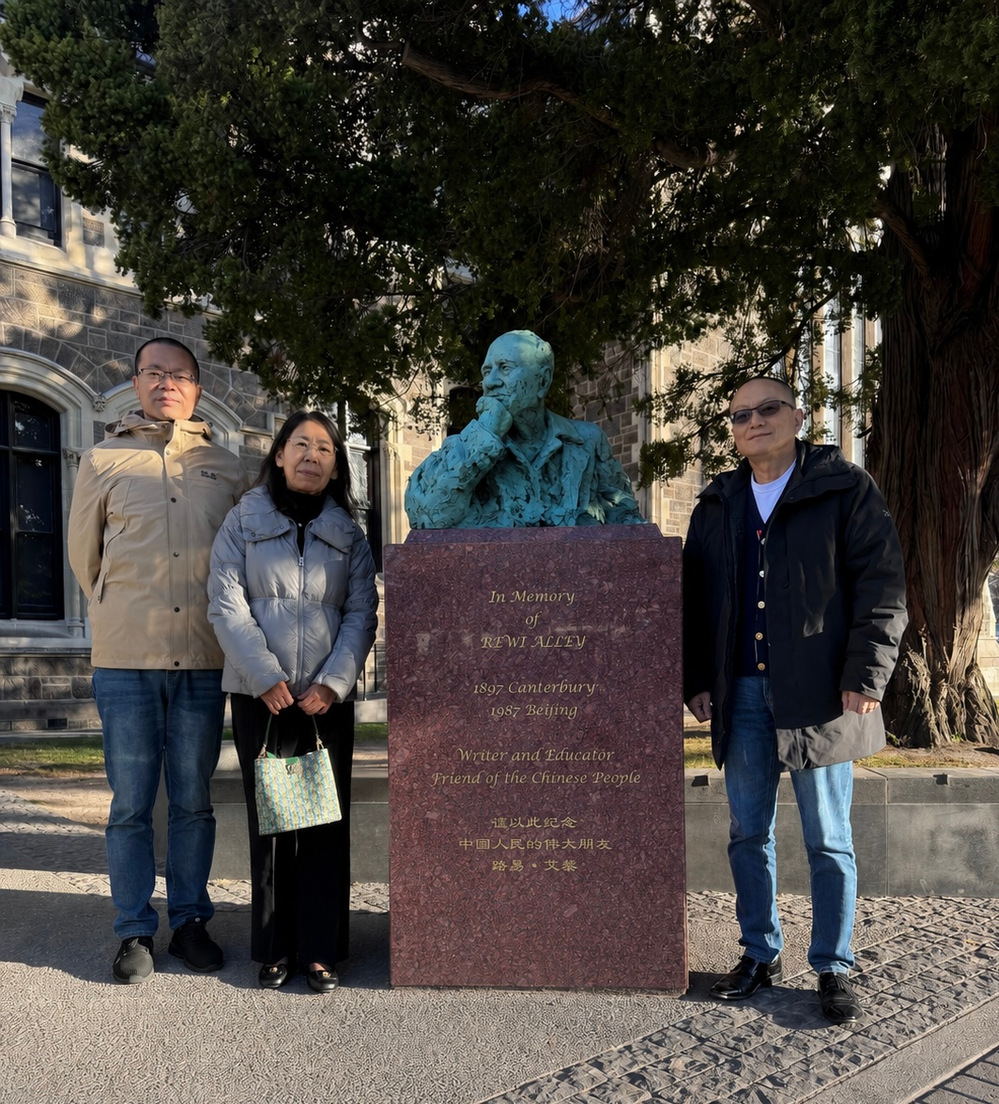
On 10 June 2026, SDC’s President He Ying led a delegation on a visit to UUNZ Institute of Business in New Zealand. The delegation held in-depth exchanges with Rex Morgan, Director of UUNZ Institute of Business, and President Cathy Zhang. Participants revisited Rewi Alley’s touching life story and conducted a detailed field tour of the Rewi Alley Memorial Hall housed within the institute.On 11 June, en route to Lincoln University, the delegation made a special trip to Rewi Alley’s former residence in Christchurch, where they posed for photos in tribute beside the statue of Rewi Alley.
The Rewi Alley Research Institute will focus its research on Rewi Alley’s thoughts on the Gung Ho Movement, vocational education, and cultural communication.Planned advisors include the Director of New Zealand Bailie Workshop, President of Bailie College, Curator of Rewi Alley Memorial Hall, and Professor Cathy Zhang, President of UUNZ Institute of Business.Yang Rongchang, Director of the Office of Science & Technology Development (Higher Education Research Division), will serve as Director of the Institute; Long Yan, Dean of the School of Marxism, and Niu Xiaowei, Vice Dean of the School of Education, will act as Deputy Directors respectively; Wang Gai from the Office of Science & Technology Development (Higher Education Research Division) will hold the post of Secretary-General.
(Correspondent: Liu Yichen, Wang Gai)
